Shared code spreads across ecosystems
A vulnerability is discovered in one location
Fix Awareness Propagates
Code fragments silently recur across open-source projects, Stack Overflow answers, internal projects, documentation, and AI-generated code
A security issue is detected and fixed in one repository, while identical fragments elsewhere remain disconnected and unaware.
Distributed code intelligence propagates detection, remediation, and ecosystem intelligence across recurring code fragments
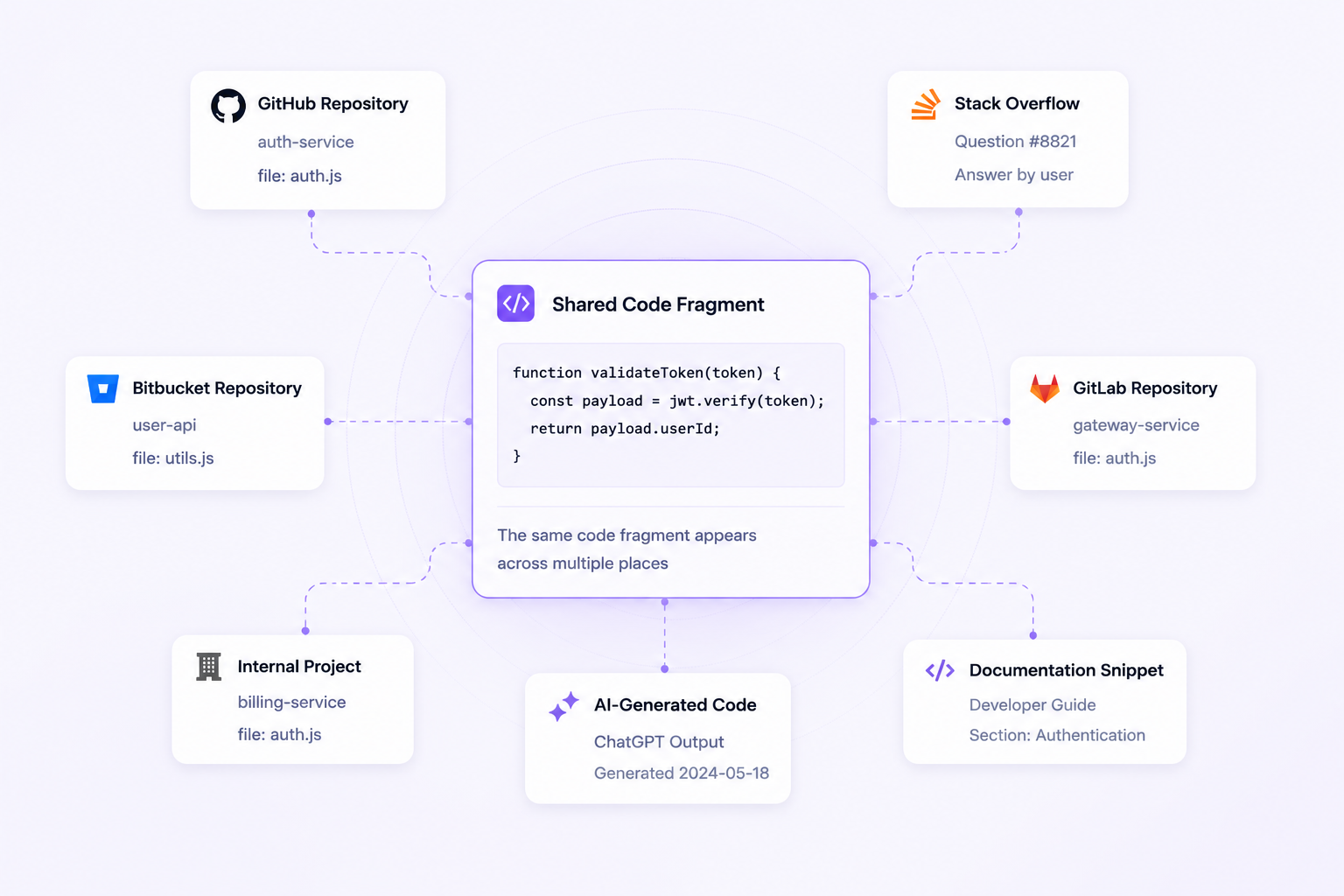
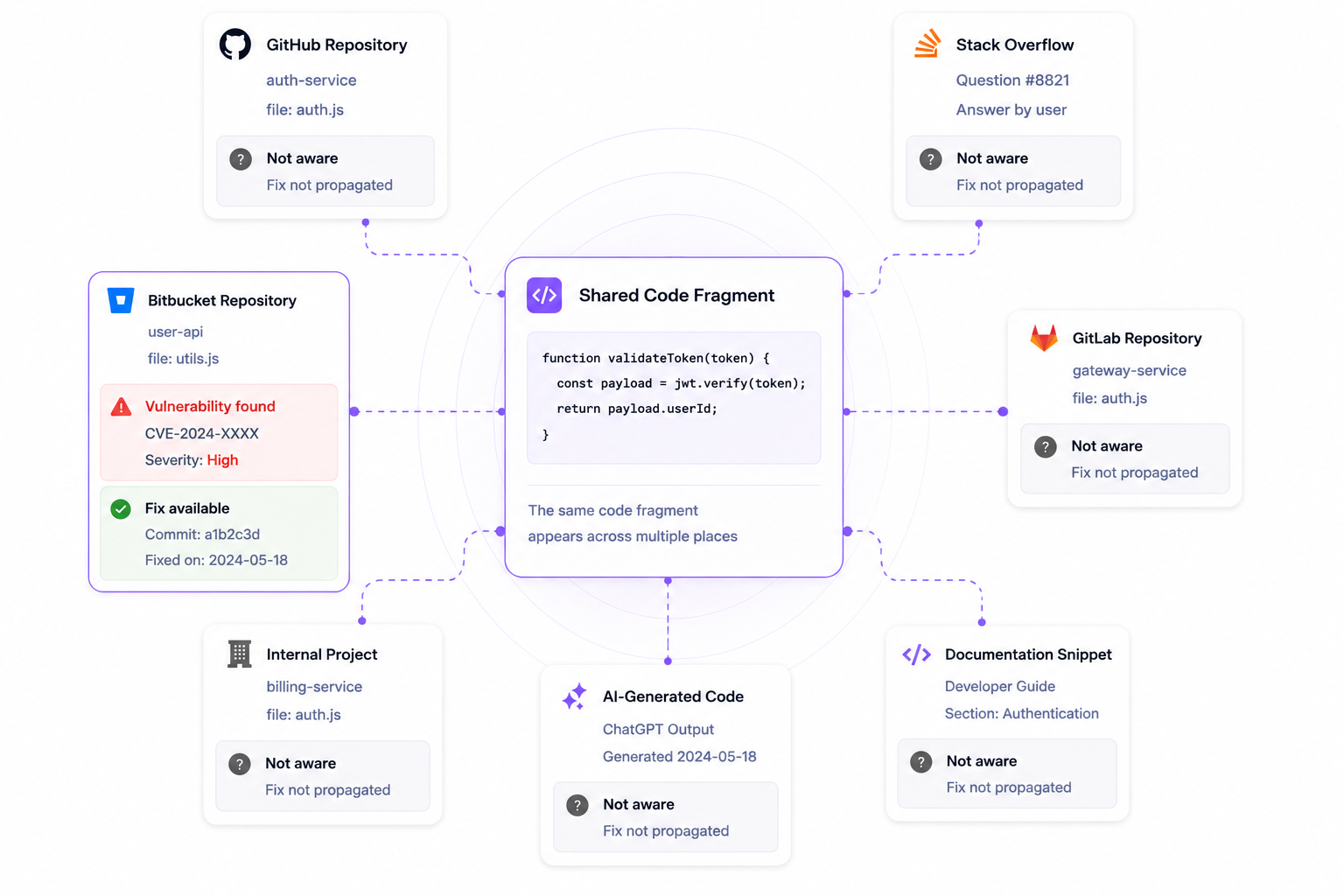
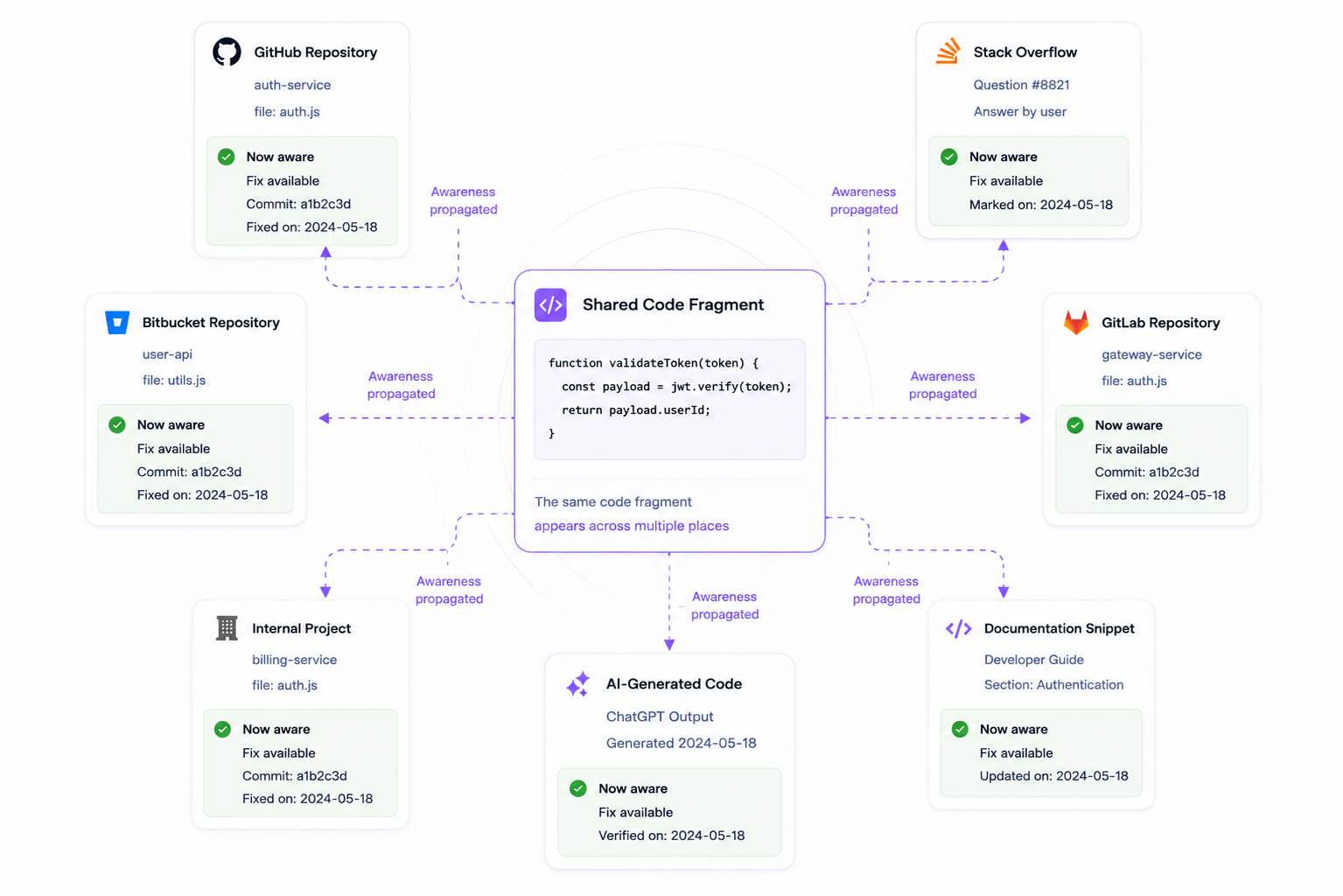
Fragmented Knowledge
How recurring code fragments become operational blind spots
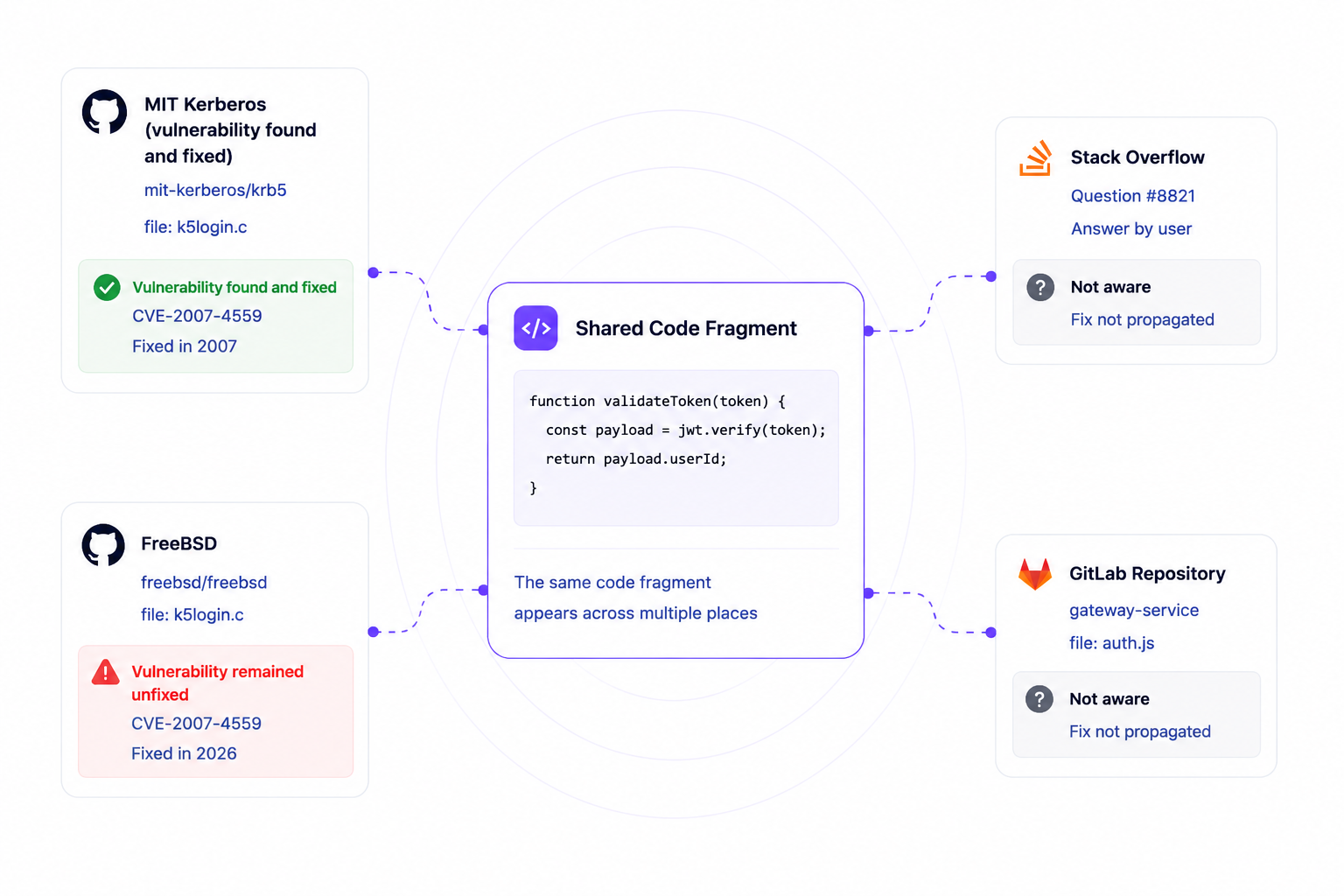
In 2007, a vulnerability in a shared code fragment was discovered, assigned a CVE, and patched in the MIT Kerberos project. Years later, researchers found that a similar fragment — copied into the FreeBSD open-source project — still contained the vulnerable logic. The original fix never propagated across the related code fragments. In 2026, Claude Mythos rediscovered and fixed the vulnerability in FreeBSD, nearly two decades after the issue had already been identified and patched in MIT Kerberos.
The projects were not directly connected through package dependencies or traditional software supply chain tooling. What connected them was something much harder to track: recurring code fragments reused across ecosystems over time. For nearly two decades, the vulnerability knowledge remained isolated to one codebase while related fragments elsewhere silently evolved independently.
We also found similar disconnected vulnerability knowledge between Stack Overflow and open-source projects. A vulnerable code fragment from Stack Overflow later appeared in the Apache Solr and Apache Chemistry projects. Although the vulnerability was eventually fixed on Stack Overflow, the maintainers of the Apache projects had no knowledge about the fix associated with the related fragment on Stack Overflow.
This is the operational blind spot of distributed code reuse
Security fixes often remain local, while semantically related fragments elsewhere in the ecosystem remain unaware of the associated fixes and continue evolving independently across open-source projects, internal systems, and Q&A forums.
Security vulnerabilities are only one example of intelligence that can become disconnected across semantically related code fragments. API deprecations, performance improvements, licensing risks, reliability fixes, and bug-related discussions across issue trackers, patch reviews, and developer forums are also intelligence that may become disconnected across related code fragments.
FAQ
Recurring code fragments are semantically or structurally similar pieces of code that appear across internal codebases, open-source repositories, Stack Overflow answers, documentations, blogs, and other sources of developer knowledge.
Although these fragments may share similar functionality, they often evolve independently over time while having similar operational and security characteristics.
Security vulnerabilities are only one example. Other forms of intelligence may also become disconnected across related fragments, including API deprecations, performance improvements, reliability fixes, licensing risks, and bug-related discussions across issue trackers, patch reviews, and developer forums.
Shared code fragments exist in unrelated open-source projects, internal company codebases, documentations, blogs, and Q&A forums and are maintained by different teams, organizations, and communities that have no shared ownership or coordination mechanisms. As a result, improvements, security fixes, bug fixes, and other valuable knowledge discovered in one fragment rarely propagates to semantically related fragments elsewhere.
Existing tooling primarily tracks dependencies between packages and libraries—not semantically related code fragments distributed across ecosystems.
Recurring code fragments are not new. However, the growing adoption of coding assistants may significantly amplify their propagation across software ecosystems and further fragment the intelligence associated with them.
By generating, adapting, and reusing code at scale, coding assistants can increase the number of semantically similar fragments distributed across repositories, documentation, Q&A forums, and internal codebases, making effective mechanisms for sharing knowledge across related fragments increasingly important.
Traditional Software Composition Analysis (SCA) and SBOM tools focus on dependency graphs and packaged components. Distributed code intelligence focuses on semantically related code fragments that exist outside traditional software supply chain boundaries.
Modern code analysis, semantic similarity techniques, and AI-assisted reasoning increasingly make it possible to identify related fragments across fragmented software ecosystems. Distributed code intelligence explores how operational knowledge and ecosystem intelligence can propagate across these distributed relationships.
Let's talk about distributed code intelligence
We are speaking with engineering leaders, developers, and security teams exploring challenges around distributed code intelligence.